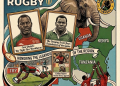


The East African Hall of Fame Part One

Who is Missing
For a try to be scored by a wing, a collective effort to win the ball, to retain it and to improve on its quality, has been made by the other 14, 9 or 6 players. Similarly, for a defence to hold out, every man who tackles must do so knowing that his/her teammate is the other link in the defensive chain that must not be broken.
To succeed in keeping one’s line intact is as gratifying to a true rugby player as the scoring of a try and it is this interdependence and team work that make this sport unique. Any rugby team is the sum total of several parts, scrummage, half backs, centres, wingers.
Forwards and particularly props never really get the recognition they deserve. After all it is the glamour of pace and deception, jinxing runs, switches, threaded grubbers, drop goals often the result of fine handling, that brings crowds to their feet with a total disregard for the hard work put in by the tight five, the octet and the eight some reelers to make the spectacle possible. They also do not endear themselves to crowds because they are quiet, unsmiling and seemingly humorless.
When you come to the forwards it’s the front row glued together like Siamese twins, utterly devoted to each other on the pitch and off it. When you seek out a prop ask the hooker and vice-versa.
Speaking to Kenyan born 3 time British & Irish Lion, Simon Shaw MBE- hapa kwa forwards ndio maneno yote. Then come to the two locks, the two towering bean poles or twin towers winning lineouts’ or ensuring a stable scrum. The back row-6-7-8 or is it 6-8-7 as the South Africans insist.
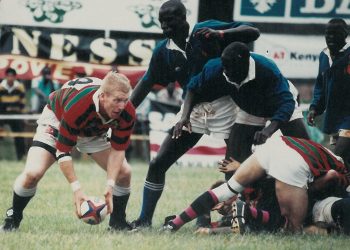
The three musketeers, who come in triplicate, strength, bravery, bottle. Simon Reynolds, Mike Andrews and Robert Balfour-Laing or Tom Oketch, David Sakari and Frank Ojiambo. Speed, defiance, disruption. George Barbour, David Parker and Peter Hiley, or Mike Evans, Max Munaifu and Rod Evans.
Tenacity, cunning, imagination. James Bichange Nyamwange, Dennis Awori and Richard Foster or Jimmy Ayoki, Brian Granville-Ross and Lord John Tarbitt. The back row controls the tiller, the brake & the accelerator. Arthos, Porthos and Aramis or Arthos, Aramis, Porthos if you are South African. One for all and all for one.
So, who sits at the very top most plinth of scrumhalves in the East Africa hall of fame? Before the log began to be writ indelibly, were all scrumhalves- till say Matheus Johannes Uys ‘Stompie’ Jones-little India rubber jeepsian mud larks with a dive pass like Kevin Lillis or Peter Belsoi?
Who is the most celebrated of all for purity of pass-Kevin Lilis or Godfrey Chief Edebe? For power, strength, flowing, whipcord-wristed pass. What about the up your combativeness of the best flankers, the speed and acceleration and blink for a gap of the finest centre, the put it about oomph and stomach for battle of any number 8.
What about fly-halves? Those with power and incisive rugby brains capable of carving up defences and setting up the centre’s with giant boots kicking for points and territory. Rob Rowland, Dave Evans, Ron Chambers, Absalom ‘Bimbo’ Mutere, John Moore Ohaga or Sammy Wavomba Khakame.Daniel Kimoro, Terry Tory, Nick Paterson, Edward Rombo, Ted Kabetu and Arnie Mitchell were wingers streaked with voluptuous Latin flamboyance and lightning speed and acceleration. Who are our centres Jackson Omaido, Jimmy Owino, Arnie Mitchell, Gordon Bell the ubiquitous John Muhato, Cecil Irvine or Bethuel Omolo?
The only disadvantage is that the game was not properly covered by television. Television immortalizes the game. As soon as a player is out of the changing room or tunnel and gets to playing day he/she collides with the intensity of the playing atmosphere. Bang! Cheers, Boos and catcalls. They are all scaring or uplifting. Here goes:
Is the list controversial?