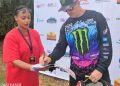


NAIROBI, March 14, 2026 — Carl Tundo has won the Safari Rally five times. He has navigated the Great Rift Valley at speeds that make ordinary drivers flinch, mastered surfaces that have broken world champions, and built a legacy that places him alongside the great Shekhar Mehta in Kenya’s motorsport pantheon. None of it, he says, was as hard as the past two weeks.

“This is the hardest thing I’ve ever had to do. Driving is easy. Because I’m not used to this.”
The 53-year-old was preparing for what would have been his 26th Safari Rally start when the phone rang. On the other end was President William Ruto, with a request that would change everything.
The Call
“About two weeks ago, I got called up by His Excellency President William Ruto who requested that I step in,” Tundo recalls. “It was almost like an emergency. I asked him if he wanted me to be Clerk of Course. He said not Clerk of Course — but CEO of the event, to push the preparations of the rally.”
His plea that he had already entered as a competitor was met with a characteristically terse response from the Head of State: not this year.
“It’s a shame as it would have been my 26th Safari Rally and I was really looking forward to it, especially with the weather as well,” Tundo admits, a trace of the competitor’s disappointment still audible in his voice. But true to the instinct that earned him his nickname, Flash shifted gears fast and has barely stopped since.
“I have barely slept over the past two weeks as we put everything together despite the limited budget. I am thankful to the sporting team who had done a wonderful job with preparations.”
A New Era for the Safari Rally
Tundo’s surprise appointment as Head of Secretariat ushered in more than a change of personnel. It signalled a structural transformation. The government ceded operational control to the corporate sector through a public-private partnership, with gaming firm SportPesa stepping in as title sponsor a model that points directly toward the fully private-sector-funded edition planned for 2027.
The results on the ground speak for themselves. With 50 entries from global, regional, and national crews including 10 WRC Rally 1 factory teams and fans descending on Naivasha from across the world, the 74th Safari Rally opened on March 12 with a momentum that belied the compressed preparation window.
Born Into It
For Tundo, none of this is abstract. The Safari Rally is not just a career landmark it is a family inheritance.
“I was born into the Safari Rally. My dad used to do it, so it was an easy call. You just got to keep this heritage going. Whether I’m driving or trying to help organise, keeping it here is the main thing. I’m getting grey anyway, so it’s okay. I’ve done enough in my day.”
That heritage stretches back to 1953, when the event began as the East Africa Coronation Rally and grew into the most celebrated gravel event on the planet. The WRC pulled out in 2002, and it took 19 long years before the championship returned. For much of that interval, the Safari Rally survived as a cornerstone of the FIA Africa Rally Championship and it was in that era that Tundo became its most dominant figure, winning in 2004, 2009, 2011, 2012, and 2018.
Now, with the Safari on the verge of signing a new five-year deal with the WRC Promoter, the man who did most to keep it relevant during the wilderness years finds himself responsible for securing its future.
What Is at Stake
Tundo is under no illusions about the size of the task or the size of the prize.
“The Safari Rally is huge. We get at least 10,000 visitors coming through here. Motorsport enthusiasts around the world come to Kenya after they watch it. I may not know the exact figures, but I know it is super important for us.”
Beyond tourism, he sees the event as Kenya’s most powerful piece of global storytelling. “It’s very important for the promotion of the country worldwide 100%. It shows the beauty, it shows the culture, it shows the people of Kenya. It shows an amazing country.”
His immediate priority is securing that five-year WRC extension. “I think it’s really important for the whole championship to have an event in Africa. Having an event like the Safari Rally is crucial it’s like no other.”
Unfinished Business
But Tundo’s ambitions extend beyond the Safari Rally itself. He is equally passionate about rebuilding the Kenya National Rally Championship, which he describes with barely concealed frustration as being at a standstill.
“We don’t have a championship anymore. The WRC Safari Rally is now in its sixth year and we should at least be having 30 to 40 local entries in the WRC2 and WRC3 categories. We’re at a stalemate at the moment but we will hopefully resolve this.”
His broader vision is a self-sustaining motorsport ecosystem: a thriving local championship feeding talent into an internationally renowned anchor event, supported by private investment and accountable governance.
“My intention is just to make it grow better and better. We will focus more on increasing its social impact not only in Nakuru County but across the entire country.”
The Hardest Stage Yet
There is something quietly poetic about the moment Kenya finds itself in. The driver who did more than anyone to keep the Safari Rally alive during its years away from the WRC is now the man tasked with securing its next chapter. The competitor who mastered every surface the Great Rift Valley could throw at him is now navigating boardrooms, sponsor negotiations, and federation politics without a co-driver, and without a pace note in sight.
Flash has always driven fast under pressure. The question now is whether the boardroom can keep up with him.