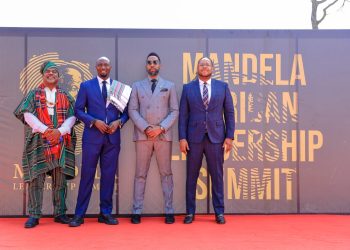


Op-ed At the Mandela African Leadership Summit in Nairobi, a quiet ideological shift became visible. Africa is no longer asking to be developed. It is positioning itself to be owned by Africans at home and abroad.

Diaspora’s Role in Africa’s New Economy are they going to be Pioneers of Progress?
By Wairimu Nyathira
NAIROBI — February 5–6, 2026: At the inaugural Mandela African Leadership Summit—convened at the Glee Hotel the legacy of Nelson Mandela was summoned to purpose. Founded by his grandson, Ndaba Mandela, the summit called for a strategic shift from “symbolism to strategy,” urging a new generation to lead Africa’s economic and digital future.
This was not a summit obsessed with what Africa lacks. It was a summit focused on what Africa is reclaiming and Nairobi positioning its self as international hub, steadily emerging as a working laboratory: where Africa is testing new ideas about ownership, energy, technology, and sovereignty. More significantly, it is becoming a gateway for the Sixth Region, the African Diaspora, to move from sentimental visitors to strategic pioneers.
https://www.youtube.com/watch?v=UbqF7-GWub0
A Shared Heritage of Value
The political DNA of South Africa and Kenya shares a common thread. Both nations navigated the difficult transition from colonial administration to majority rule through liberation movements that framed freedom as dignity, not simply independence.
At the summit, that liberation language was reborn in economic terms. A room charged with Afro-optimism erupted in chants at the mention of Burkina Faso’s President, Captain Ibrahim Traoré a reflection of a continental hunger for leaders who speak directly about sovereignty, courage, and self-belief.
Chief Dr. Wilton McDonald reminded delegates that Africa has historically been “set up for extraction,” and that this reality must be confronted if the continent is to reposition itself as an economic power rather than a perpetual development project.
“Why do we need external giants to tell us what we must build? Africans have the capacity to build, own, and govern our own systems.” H.E. Jacques Baril
The Summit as a Living Classroom
Beyond keynote speeches, the summit functioned as a high-level classroom for strategic thinking and talent development.
In sessions led by iBen Adanju, participants watched ideas being deconstructed and rebuilt in real time. Questions were stripped to their essence, reframed as opportunities, and transformed into executable strategy.
It was a demonstration of a deeper truth: Africa does not only need capital. It needs thinkers, builders, and institutional architects.
The Silicon Savannah and Africa’s Hardware
Kenya’s Silicon Savannah is often discussed in terms of software, startups, fintech, apps, and platforms. But every digital economy requires hardware.
That hardware exists in Konza Technopolis, a 5,000-acre smart city and Special Economic Zone housing Kenya’s Tier III National Data Centre.
When African data lives on African soil, digital wealth can be generated, stored, and leveraged within African systems.
Infrastructure as a Philosophy
One of the most compelling innovations showcased at the summit was Aquaboost, a technology capable of generating electricity using salt and water.Its importance lies not only in engineering, but in philosophy.
Across Africa, extending national grid infrastructure to remote communities costs billions, often with minimal return. Yet hundreds of millions of Africans remain without electricity.
Aquaboost reimagines infrastructure as mobile, and community-scale.It suggests a future where power can be deployed in refugee camps, rural schools, training centres, and sports facilities creating safe spaces without waiting for massive grid expansion.
To me, Aquaboost represents African self-reliance. It reflects a broader shift toward solutions designed for African realities.
From Remittances to Ownership
For decades, the African Diaspora has played a critical role in sustaining families and communities through remittances.
These contributions matter, however Africa’s new economy requires more than consumption support. It requires ownership participation.
The summit’s underlying message to the Diaspora was clear: Africa does not need more sentimental visitors. It needs pioneers. Pioneers who invest early. Pioneers who bring skills and governance experience. Pioneers who accept risk in exchange for long-term stake.
With artificial intelligence projected to disrupt global labour markets by 2030 and Africa holding the world’s largest youth population, the stakes could not be higher.
This call to ownership was punctuated by Ndaba Mandela, who reminded the summit that Africa’s transformation requires more than just high-tech dreams, it requires a fundamental commitment to institutional integrity
“We are moving from symbolism to strategy,” Mandela noted. “Nairobi is where we unite the continent’s brainpower to build a future that doesn’t just emulate global models it surpasses them.”
A Continent Reclaiming Its Future
What unfolded in at the summit was a signal. A signal that Africa is moving deliberately toward an economy anchored in sovereignty, self-belief, and structural ownership.
My take is timing matters. Being present while ecosystems are forming creates influence that cannot be bought later.
For the diaspora, the invitation is open, come now, come to build, come to partner, come to own. The era of the pioneer has begun.
https://www.youtube.com/watch?v=UbqF7-GWub0&t=193s
Footnotes
[1] The ROI Critique & Energy Target: Per the Kenya National Energy Compact (2025–2030), Kenya is on track for a 100% renewable mix. However, research by Ted Miguel (UC Berkeley) and 2025 parliamentary energy reports highlight the diminishing returns of traditional grid expansion: connecting a rural household often costs over $1,000, while generating less than $2.00 in monthly revenue. This has contributed to a “statutory debt” in the energy sector exceeding KSh 30 billion as of late 2025.
[2] The Sixth Region: Recognized by the African Union in 2003, this region consists of people of African descent living outside the continent.
[3] Konza Technopolis: A 5,000-acre Vision 2030 flagship project and Special Economic Zone. It houses the National Data Centre, enabling data sovereignty.